
Most couples spend between $2,500 and $5,000 on an engagement ring, with the national average ranging from $5,500 to $6,000. However, 40% of buyers spend less than $2,500, proving that beautiful, meaningful rings are available at every budget level. The final cost depends primarily on the diamond’s 4 C’s (cut, color, clarity, carat), setting style, and metal choice, with significant savings possible through lab-grown diamonds, alternative gemstones, and strategic shopping.
If you’re feeling overwhelmed by engagement ring costs or worried about meeting unrealistic expectations, you’re not alone. The outdated “two months’ salary” rule has created unnecessary financial pressure, when the reality is that engagement ring prices should align with your personal budget and financial goals. This guide breaks down everything you need to know about engagement ring costs, helping you make an informed decision that celebrates your commitment without compromising your financial future.
Average Engagement Ring Costs by Market Segment
The national average engagement ring cost ranges from $5,500 to $6,000, but this figure can be misleading since it’s heavily skewed by luxury purchases. The median cost, which better represents what most couples spend, sits closer to $3,000 to $4,000. Understanding where you fit in the market helps set realistic expectations.
| Price Range | Percentage of Buyers | Market Segment |
| Under $1,000 | 15% | Budget-conscious |
| $1,000 – $2,500 | 25% | Entry Level |
| $2,500 – $5,000 | 30% | Mid-range |
| $5,000 – $10,000 | 20% | Premium |
| $10,000+ | 10% | Luxury |
Regional spending patterns show significant variation, with couples in major metropolitan areas typically spending 20-30% more than those in smaller cities. Generational differences also play a role: Gen Z couples tend to prioritize value and alternative stones, while Millennials often focus on ethical sourcing and lab-grown diamonds. Gen X buyers typically have higher budgets but are more practical in their approach to ring selection.
The gap between average and median costs reveals an important truth about engagement ring shopping: a small percentage of very expensive purchases inflate the average, while most couples spend significantly less than often-quoted figures suggest.
The 4 C’s and Their Impact on Price
Diamond pricing follows a complex matrix based on the famous 4 C’s, with each characteristic dramatically affecting the final cost. Understanding how these factors interact helps you maximize value within your budget.
Engagement Ring Cost by Carat Weight
Carat weight has the most dramatic impact on price, but the relationship isn’t linear. As diamonds increase in size, the price per carat escalates significantly because larger stones are exponentially rarer.
The table below illustrates the average cost per carat for natural diamonds.
| Carat Weight | Average Price Range | Price Per Carat |
| 0.5ct | $1,200 – $2,500 | $2,400 – $5,000 |
| 0.75ct | $2,000 – $4,500 | $2,700 – $6,000 |
| 1.0ct | $3,500 – $8,000 | $3,500 – $8,000 |
| 1.5ct | $6,000 – $15,000 | $4,000 – $10,000 |
| 2.0ct | $12,000 – $25,000 | $6,000 – $12,500 |
Engagement Ring Cost by Cut Quality
Cut quality affects both brilliance and price. Round brilliant cuts command premium pricing due to their popularity and the amount of rough diamond lost during cutting. Fancy cuts like oval, pear, or marquise can offer 10-20% savings while providing unique aesthetic appeal.
Engagement Ring Cost by Color
Color grading ranges from D (colorless) to Z (light yellow). The sweet spot for value lies in the G-J range, where slight color differences are virtually undetectable to the untrained eye but can save 15-25% compared to colorless grades.
Engagement Ring Cost by Clarity
Clarity measures internal and external flaws. While flawless diamonds command top prices, SI1 and SI2 grades offer excellent value, with inclusions typically invisible without magnification. This represents one of the best opportunities for budget-conscious buyers to maximize carat weight within their price range.
Setting Styles and Metal Choices
The setting style significantly impacts both the ring’s appearance and total cost. Labor-intensive designs with intricate details naturally command higher prices, while classic styles offer timeless appeal at more accessible price points.
| Setting Style | Price Range | Metal Requirement | Complexity Level |
| Solitaire | $300 – $1,500 | Low | Simple |
| Halo | $800 – $3,000 | Medium | Moderate |
| Three-stone | $1,000 – $4,000 | Medium-High | Moderate |
| Vintage/Antique | $1,200 – $5,000 | High | Complex |
| Pavé | $1,500 – $6,000 | High | Complex |
Metal choice adds another layer of cost consideration. Platinum commands the highest prices due to its purity and durability but requires less maintenance over time. White gold offers a similar appearance at 20-30% less cost, though it may need periodic rhodium plating. Yellow and rose gold typically cost less than white metals and have gained popularity for their vintage appeal and skin tone compatibility.
Consider long-term maintenance costs when selecting metals. While platinum has higher upfront costs, its durability and hypoallergenic properties may provide better value over decades of wear.
Alternative Options and Budget-Friendly Strategies
Smart couples increasingly explore alternatives to traditional natural diamonds, finding beautiful options that align with both their values and budgets. These alternatives can dramatically reduce costs without compromising on beauty or meaning.
| Stone Type | Average Cost | Durability (Mohs Scale) | Brilliance Factor |
| Natural Diamond | $5,000 – $8,000 | 10 | Excellent |
| Lab Diamond | $3,000 – $5,000 | 10 | Excellent |
| Moissanite | $1,500 – $2,500 | 9.25 | Superior |
| White Sapphire | $800 – $1,500 | 9 | Good |
| Cubic Zirconia | $50 – $200 | 8.5 | Fair |
Lab-grown diamonds offer identical physical and chemical properties to natural diamonds at 30-40% savings. They’re increasingly accepted by consumers who value the ethical sourcing and environmental benefits alongside the cost savings.
Moissanite provides exceptional brilliance that actually exceeds diamonds, with fire and sparkle that many find more appealing than traditional stones. At roughly 60-70% less than comparable diamonds, moissanite offers outstanding value for budget-conscious couples.
Strategic shopping techniques can further reduce costs. Consider diamonds slightly below popular carat weights (0.9 instead of 1.0 carat) for significant savings with minimal visual difference. Online retailers often offer 20-40% savings compared to traditional jewelry stores, though you’ll sacrifice the in-person experience and immediate gratification.
Regional and Cultural Variations
Geography plays a surprising role in engagement ring costs, with regional variations reflecting both local economic conditions and cultural expectations.
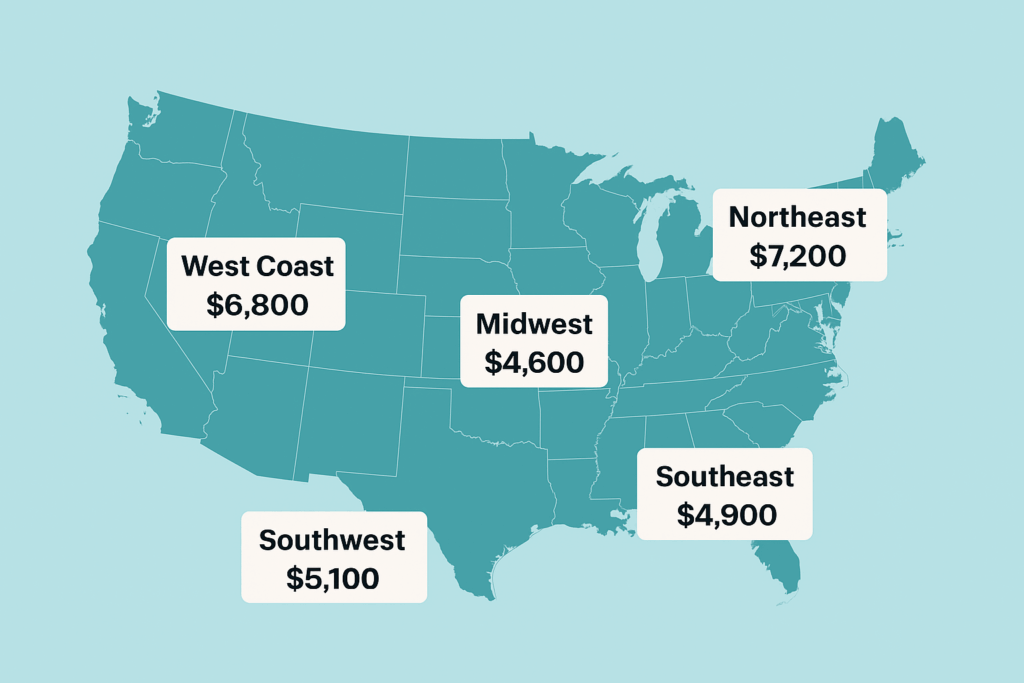
| Region | Average Cost | Cost of Living Factor |
| Northeast | $7,200 | High |
| West Coast | $6,800 | High |
| Southeast | $4,900 | Medium |
| Midwest | $4,600 | Medium |
| Southwest | $5,100 | Medium |
Major metropolitan areas like New York, San Francisco, and Los Angeles see average costs 30-50% higher than national averages, driven by higher incomes, elevated cost of living, and competitive social pressures. Rural areas and smaller cities typically see more conservative spending patterns that better align with national median figures.
Cultural factors also influence spending patterns. Some communities maintain strong traditions around ring styles and investment levels, while others prioritize practical considerations or alternative expressions of commitment.
Practical Budgeting and Financing Advice
Financial experts suggest spending 10-15% of your annual income on an engagement ring, a more realistic guideline than the outdated two-month salary rule. This approach considers your overall financial health, including existing debt, savings goals, and upcoming wedding expenses.
Before financing an engagement ring, consider the total cost including interest. Many jewelers offer 0% financing for qualified buyers, but read the terms carefully. Missing payments can result in retroactive interest charges that dramatically increase the total cost.
Don’t forget ongoing expenses: insurance typically costs $1-2 per $100 of ring value annually, and periodic maintenance like professional cleaning, prong tightening, and potential stone replacement should factor into your long-term budget.
Many retailers offer upgrade programs that allow you to trade in your original ring toward a larger stone later, providing flexibility as your financial situation changes.
Making the Right Choice for Your Relationship
Engagement ring costs ultimately depend on your personal values, financial situation, and relationship priorities rather than external expectations or marketing pressures. The most meaningful rings are those chosen thoughtfully within a comfortable budget, allowing you to focus on your future together rather than financial stress.
Remember that your partner will wear this ring daily for decades. Consider their lifestyle, personal style preferences, and practical needs alongside your budget constraints. A well-chosen $2,000 ring that perfectly suits their taste and daily activities will bring more joy than an expensive ring that sits unworn in a jewelry box.
Take time to research, compare options, and shop around before making this significant purchase. With careful planning and realistic expectations, you can find a beautiful engagement ring that celebrates your commitment without compromising your financial future.
Most people in the United States spend between $2,500 and $5,000 on their engagement ring.
A 2-carat engagement ring can vary widely in cost depending on the stone and quality. For a natural diamond with good color, clarity, and cut, expect to pay between $10,000 and $20,000 or more. Lab-grown diamonds offer a similar look at a lower price, typically ranging from $3,000 to $7,000. More modest natural diamonds or simpler settings may start around $5,000, though this often means compromising on quality. Alternatives like moissanite or low-quality diamonds can cost under $1,000 but fall into a different category altogether.
A 3-carat engagement ring can vary widely in price depending on whether the diamond is natural or lab-grown, as well as its cut, clarity, color, and setting. For a natural 3-carat diamond of good quality, you can typically expect to spend between $20,000 and $50,000 or more, with higher-end stones costing significantly above that. Lab-grown 3-carat diamonds are a more affordable option, usually ranging from $2,000 to $10,000 depending on quality and design.
A 4-carat engagement ring can cost well over $40,000 for a natural diamond of decent quality, and can rise to $200,000 or more for top-tier color, clarity and cut. For lab-grown alternatives, 4-carat rings may start around $3,000 to $10,000, depending heavily on setting and brand.
A 5-carat engagement ring can cost well over $50,000 for a natural diamond of decent quality and easily exceed $100,000 (even reaching $200,000+) for top-tier color, clarity and cut. On the other hand, lab-grown versions of 5-carat rings can start as low as $4,000 to $10,000 depending on the setting and brand.
A natural diamond engagement ring typically costs between $5,000 and $20,000, depending on the diamond’s size, cut, color, and clarity. Larger or higher-quality stones, as well as designer settings, can raise the price to $30,000 or well over $50,000.
A lab-grown diamond engagement ring often costs significantly less than a comparable natural diamond, typically ranging from $2,000 to $8,000, depending on size, cut, and setting. Premium lab-grown rings with large carat weight or designer settings may reach $10,000 or more, but still generally remain below equivalent natural diamond prices.
Yes, you can finance an engagement ring through jewelers, banks, or third-party lenders that offer monthly payment plans. Just be sure to review interest rates, terms, and your budget to make sure the financing is affordable and fits your financial situation.
The cost of an engagement ring per month depends on the financing options you choose. Many online retailers offer interest free financing for engagement ring purchases. Monthly payments typically range between $100 and $1,000.